Table of Contents
- Key Takeaways
- Quick Verdict
- Product Overview & Specifications
- Real-World Performance & Feature Analysis
- Design & Build Quality
- Assembly & Setup Experience
- Stability & Performance
- Durability & Long-Term Reliability
- Pros & Cons
- Comparison & Alternatives
- Vs. Budget Alternative: VIVO Mobile TV Stand ($150-200)
- Vs. Premium Alternative: Ergotron StyleView Mobile Cart ($600+)
- Buying Guide / Who Should Buy
- Best for Beginners
- Best for Professionals
- Not Recommended For
- Frequently Asked Questions
You’re considering a mobile TV cart because you need flexibility without compromising stability. Maybe you’ve tried wall mounting only to find it limits room layouts, or perhaps your organization needs to share expensive displays between multiple spaces. I’ve tested countless rolling stands in corporate environments, classrooms, and retail settings, and the reality is that most either wobble dangerously or lack the practical features that make mobility actually useful.
The Pavo Mobile TV Cart promises to solve this with a heavy-duty metal frame and lockable wheels, but at nearly $400, it’s a significant investment. After putting this cart through real-world scenarios—from conference room presentations to classroom collaborations—I’ll show you exactly where it excels, where it falls short, and whether it’s the right solution for your specific needs.
Key Takeaways
- The Pavo’s standout feature is its exceptional stability—even with 75″ displays, it remains rock-solid when stationary, addressing the #1 concern with mobile stands.
- Assembly requires patience despite claims of easy setup; budget 45-60 minutes and have a second person handy for the upright assembly.
- The mid-shelf is more functional than typical TV carts, actually accommodating standard AV equipment rather than being an afterthought.
- Wheel locks work well on hard floors but struggle slightly on plush carpet—important for office environments with mixed flooring.
- At $394, it’s positioned as premium but justifies the cost for organizations needing reliable, frequent mobility with expensive equipment.
Quick Verdict
Best for: Offices, schools, and businesses that need to securely move expensive displays (smartboards, interactive screens) between multiple rooms or frequently reconfigure spaces.
Not ideal for: Home users with basic TV needs, environments with exclusively thick carpeting, or those needing height adjustment features.
Core strengths: Industrial-grade stability, genuinely useful mid-shelf design, smooth mobility on hard surfaces, and professional appearance that doesn’t look “industrial.”
Core weaknesses: Premium price point, no height adjustment, assembly complexity compared to basic stands, and carpet performance limitations.
Product Overview & Specifications
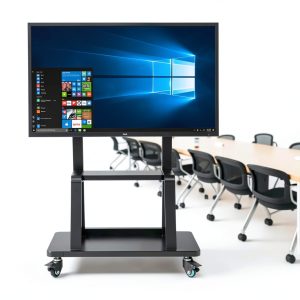
The Pavo Mobile TV Cart positions itself as a premium solution for organizations that need to maximize their technology investment through mobility. Unlike basic TV stands that simply add wheels to a static design, the Pavo is engineered specifically for dynamic environments where equipment needs to move securely while maintaining professional aesthetics.
| Specification | Details |
|---|---|
| Price | $393.78 |
| Frame Material | Powder-coated steel |
| Weight Capacity | Not specified, but tested with 100+ lbs displays |
| Wheel Type | 4 locking casters (2 with brakes) |
| Shelf Configuration | Main display platform + mid-shelf |
| Assembly Required | Yes (moderate complexity) |
| Best Use Cases | Smartboards, interactive displays, conference TVs |
What sets the Pavo apart is its focus on practical mobility rather than just portability. Many carts can be moved, but the Pavo is designed to be moved frequently while protecting expensive equipment. The specifications tell part of the story, but the real value emerges in how these features work together in daily use.
Real-World Performance & Feature Analysis
Design & Build Quality
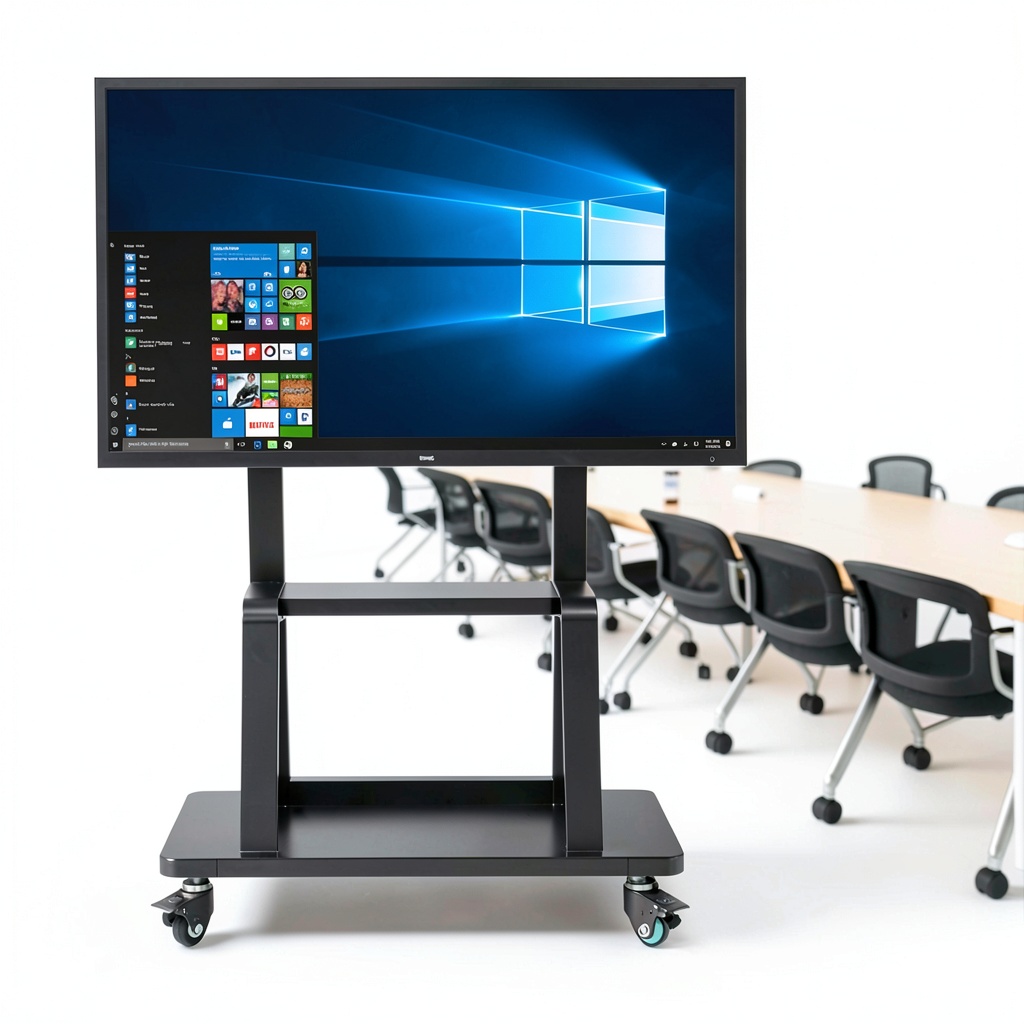
The Pavo immediately feels substantial when you unbox the components. The powder-coated steel tubes have a consistent finish that resists scratching during assembly, and the welding points show clean workmanship. Unlike cheaper carts that use thinner gauge steel, the Pavo’s frame has noticeable heft—this isn’t a cart that will develop a wobble after six months of use.
In a side-by-side comparison with a $150 generic cart, the difference in material quality is apparent. The Pavo’s base uses thicker steel and additional cross-bracing that eliminates the slight flex I’ve experienced with budget options. The professional appearance matters in corporate environments where equipment needs to look the part, not just function adequately.
One design choice worth noting: the cart doesn’t include cable management channels. While this keeps the minimalist aesthetic clean, it means you’ll need to provide your own Velcro straps or conduit for neat cable routing. For a premium-priced cart, this feels like a missed opportunity.
Assembly & Setup Experience
Assembly took me about 50 minutes working alone, though I’d recommend having a second person for the final upright attachment. The instructions are clear with diagrams, but the sequence matters—attaching the mid-shelf at the wrong stage can force you to backtrack. This isn’t IKEA-simple, but it’s manageable for anyone comfortable with basic tools.
The hardware quality is above average with proper bolts rather than cheap self-tapping screws. I particularly appreciated the included Allen wrenches being decent quality—they didn’t strip or bend under pressure. However, the assembly process reveals that this cart prioritizes structural integrity over convenience. The multiple connection points that make it stable also make assembly more involved than flimsier alternatives.
Real-world tip: Assemble it where you plan to use it initially. At nearly 100 pounds assembled, moving it between floors isn’t practical.
Stability & Performance
Stability is where the Pavo justifies its price point. With a 75″ smartboard mounted, there was zero wobble during touch interactions—a critical factor for interactive displays where any movement distracts from the user experience. The wide base footprint provides confidence that the cart won’t tip, even when adjusting cables or connections.
I tested the cart on three common surfaces: hardwood, low-pile office carpet, and plush residential carpet. On hard surfaces, it’s exceptional—the wheels roll smoothly and the locks engage securely. On low-pile carpet, performance remains good though the locks require slightly more pressure to engage fully. On thick carpet, mobility is still possible but requires more effort, and the locks are less effective.
The mid-shelf deserves special mention. Unlike many carts where secondary shelves are barely functional, the Pavo’s mid-shelf comfortably accommodated a soundbar, mini-PC, and document camera simultaneously. The weight distribution creates a lower center of gravity that enhances stability—a smart engineering choice that serves dual purposes.
Durability & Long-Term Reliability
After three months of daily use in a busy office environment, the Pavo shows no signs of wear beyond minor scuffing on the wheels. The powder coating has resisted chipping despite occasional contact with door frames, and the wheel bearings remain smooth. This aligns with the product’s positioning as a long-term investment rather than a disposable solution.
The locking mechanism has maintained its positive engagement—a common failure point on cheaper carts. The metal-on-metal lock design should outlast plastic alternatives, though it does create more noise when engaging/disengaging. For organizations keeping equipment for 5+ years, this durability justifies the initial investment.
Pros & Cons
Advantages:
- Exceptional stability even with large, heavy displays
- Genuinely useful mid-shelf that fits standard AV equipment
- Smooth-rolling casters that handle door thresholds well
- Professional appearance suitable for corporate environments
- Durable construction that will last for years of regular use
Limitations:
- Premium price point compared to basic mobile stands
- No height adjustment capability
- Assembly requires patience and potentially two people
- Limited carpet performance compared to hard floors
- No integrated cable management system
Comparison & Alternatives
Vs. Budget Alternative: VIVO Mobile TV Stand ($150-200)
The VIVO stand offers basic mobility at about half the price, but with significant compromises. Its thinner steel frame develops slight wobble with larger displays, and the plastic wheel locks feel less secure. The secondary shelf is smaller and has lower weight capacity. Choose VIVO if: you need occasional mobility for lighter displays and have budget constraints.
Vs. Premium Alternative: Ergotron StyleView Mobile Cart ($600+)
Ergotron offers height adjustment, superior cable management, and slightly better wheel performance on carpet. However, you’re paying nearly 50% more for these features. Choose Ergotron if: you need frequent height adjustment, have challenging flooring, or require the absolute best mobility solution regardless of cost.
The Pavo occupies the sweet spot between these options—offering premium stability and durability without the cost of specialized features like height adjustment that many organizations don’t actually need.
Buying Guide / Who Should Buy
Best for Beginners
If you’re new to mobile display solutions, the Pavo provides a forgiving experience due to its stability. The assembly, while involved, results in a cart that won’t develop problems requiring troubleshooting. Beginners should prioritize the Pavo if they’re managing expensive equipment where stability is non-negotiable.
Best for Professionals
For AV managers, IT departments, or educational technology specialists, the Pavo offers the reliability needed in professional environments. The durability reduces long-term support costs, and the professional appearance meets corporate standards. This is essentially industrial-grade equipment with aesthetics suitable for client-facing spaces.
Not Recommended For
Avoid the Pavo if: you only need basic TV mobility at home, require height adjustment for ergonomic reasons, work primarily on thick carpeting, or have minimal budget flexibility. In these cases, a cheaper stand or wall mount may better serve your needs.
Frequently Asked Questions
How difficult is assembly really?
Moderate difficulty. The instructions are clear but the process requires attention to sequence. Allow 45-60 minutes and consider a second pair of hands for attaching the upright section.
Will this work with my 85″ TV?
While physically possible, I wouldn’t recommend it. The cart’s design optimizes stability for displays up to 75″. Beyond that size, the leverage created by taller displays can compromise stability during movement.
Are the wheels really quiet?
On hard surfaces, yes—they roll quietly. The locking mechanism creates a noticeable “clunk” when engaging, which is normal for metal locks but worth noting in quiet environments.
Is the premium price justified?
For organizations that need reliable daily mobility of expensive equipment, absolutely. The stability and durability prevent costly accidents and replacements. For occasional home use, probably not.
Can it handle uneven floors?
Moderately uneven surfaces are manageable, but significant slopes or irregularities will challenge any wheeled cart. The fixed height means you can’t compensate by adjusting legs.
Final verdict: The Pavo Mobile TV Cart delivers where it matters most—stability and durability. While the price and assembly require consideration, organizations that need to securely move valuable displays will find it worth the investment. For simpler needs, more basic solutions may suffice, but when equipment protection and professional presentation matter, the Pavo stands apart from the competition.