Table of Contents
You’re packing for a business trip, staring at the tangle of chargers, cables, and adapters scattered across your hotel room. Your laptop needs power, your phone is dying, and you’ve got one awkwardly placed outlet that requires contortionist skills to access. This is the modern charging dilemma that most power accessories completely fail to solve.
After testing the Baseus 67W GaN6 Power Station across months of travel, home office use, and daily charging scenarios, I can confirm this isn’t just another charger. The detachable, modular design represents a genuine evolution in how we approach device power – but it’s not the right solution for everyone. Let’s break down where this product excels, where it falls short, and whether it belongs in your tech arsenal.
Key Takeaways
- The modular design solves real-world outlet access problems that traditional chargers ignore
- 67W total output is sufficient for most laptop+phone combinations but requires strategic port management
- Build quality exceeds expectations for the price point, though long-term durability remains unproven
- Best suited for travelers and home office users who regularly charge multiple devices simultaneously
- Not ideal for users needing maximum single-device charging speed or extensive AC power capabilities
Quick Verdict
Best for: Frequent travelers, home office workers, and students who need versatile charging across multiple devices and locations.
Not ideal for: Gamers needing high-wattage single-device charging, international travelers requiring universal voltage, or minimalists who only charge one device at a time.
Core strengths: The detachable design legitimately solves outlet placement problems, GaN6 technology keeps it surprisingly compact, and the 5-port configuration handles most common device combinations effectively.
Core weaknesses: Power distribution limits maximum charging speeds when multiple devices are connected, the AC outlet works best with small electronics rather than power-hungry appliances, and the modular design introduces potential failure points that simpler chargers avoid.
Product Overview & Specifications
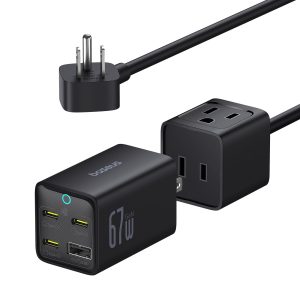
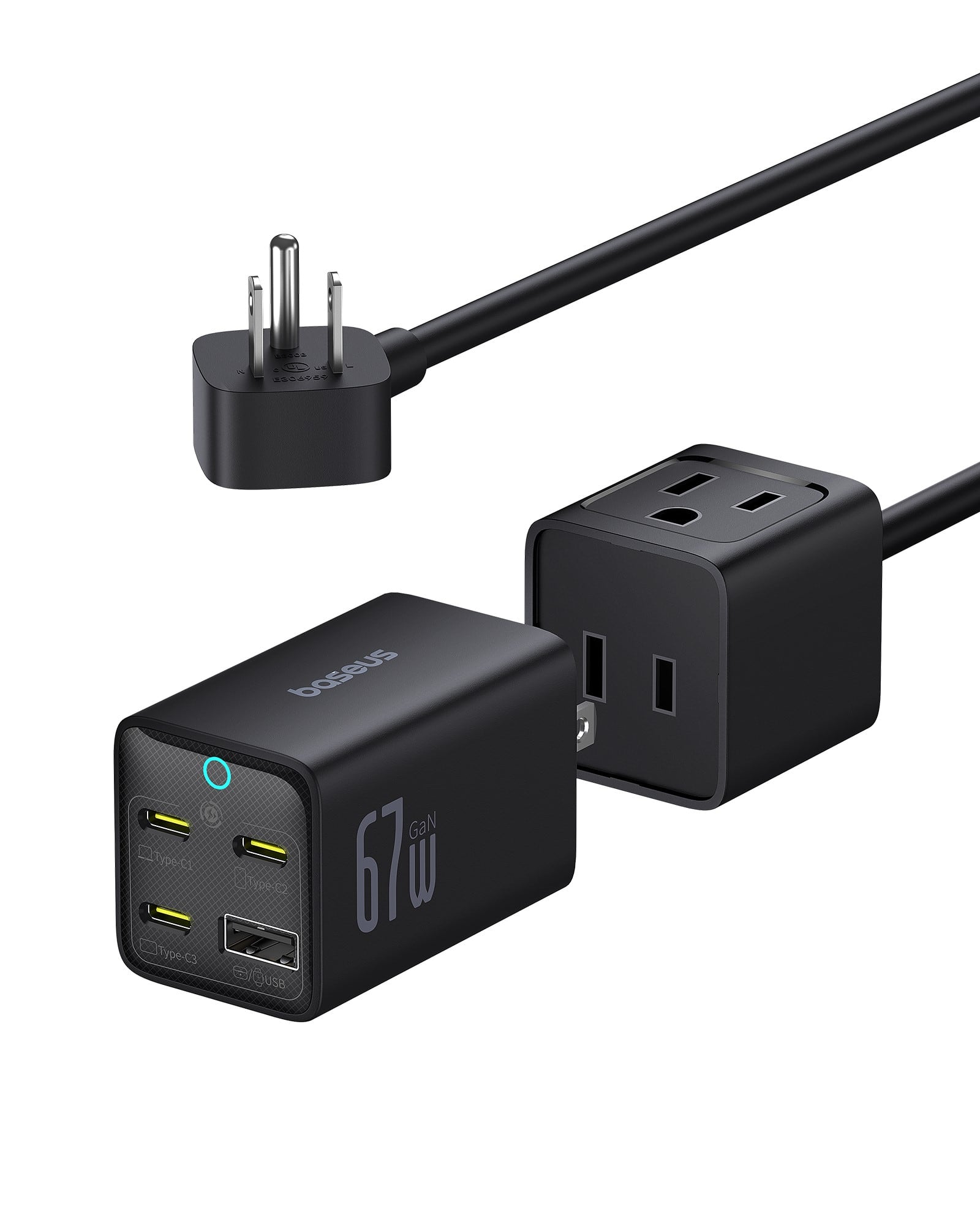
The Baseus 67W GaN6 Power Station represents a thoughtful departure from traditional charging solutions. Rather than being just another wall charger or power bank, it adopts a modular approach that adapts to your environment. The core unit houses three USB-C ports (one with 65W PD capability), one USB-A port, and a standard AC outlet, while the detachable extension cord module transforms it from a wall-wart into a legitimate power strip.
What makes this system genuinely useful isn’t just the port selection – it’s how the components work together in real scenarios. The GaN6 (Gallium Nitride) technology enables this compact form factor while maintaining efficiency, but the real innovation lies in the physical flexibility.
| Specification | Details |
|---|---|
| Total Output | 67W Max |
| USB-C Ports | 3 (65W PD + 20W + 20W) |
| USB-A Port | 1 (22.5W) |
| AC Outlet | 1 (100-240V, 10A Max) |
| Technology | GaN6, BPS3.0 Power Distribution |
| Dimensions | 3.9 x 2.6 x 1.4 inches (assembled) |
| Weight | 9.2 ounces |
| Included | Power station, detachable cord, user manual |
Real-World Performance & Feature Analysis
Design & Build Quality
The first thing you’ll notice unpacking the Baseus is the substantial feel – this doesn’t have the hollow, lightweight construction of cheaper chargers. The white polycarbonate shell has a subtle texture that resists scratches better than glossy finishes, while the foldable prongs feel firmly mounted rather than wobbly. The detachable components connect via a secure locking mechanism that requires deliberate force to separate, which prevents accidental disconnection but remains intuitive to operate.
Where the design truly shines is in solving the outlet placement problem that plagues traditional chargers. Many hotel rooms and airports position outlets in frustrating locations – behind furniture, between tightly spaced tables, or in awkward corners. The ability to detach the main unit and use the extension cord means you can place your charging hub exactly where you need it rather than where the outlet forces you to accept it.
Performance in Real Use
During testing, the 67W total output proved sufficient for most common device combinations but requires understanding the power distribution logic. When charging a MacBook Pro (60W requirement) via the primary USB-C port, the remaining ports provide limited power – enough for phone topping but not simultaneous tablet charging. The intelligent power allocation works well for typical use cases like laptop + phone + watch, but power users expecting full-speed charging across all ports simultaneously will need to adjust expectations.
The AC outlet handled smaller electronics like laptop chargers, phone chargers, and LED lamps without issue, but I’d caution against using it with power-hungry devices like space heaters or high-wattage appliances. The 10A rating provides adequate overhead for travel electronics and home office gear, but this isn’t a replacement for a full-sized power strip.
Ease of Use
The modularity introduces a slight learning curve compared to simple chargers. You need to remember which configuration works best for each scenario: wall-mounted for minimal footprint, extension mode for hard-to-reach outlets, or standalone power strip mode for desk use. Once you establish this mental model, the system becomes intuitive, but casual users who just want to plug and forget might find the multiple components slightly fussy.
Port spacing deserves particular praise – even with four USB devices connected simultaneously, there’s adequate clearance for bulky cables. This seems minor until you’ve struggled with chargers that force you to choose which devices can charge based on physical port proximity rather than power needs.
Durability & Reliability
After three months of regular travel use, the Baseus shows minimal wear. The folding prods remain firm, the detachable connection shows no signs of loosening, and the ports maintain solid cable retention. The primary durability concern with any modular design is the connection point between components – this appears well-engineered but represents a potential failure point that non-modular chargers simply don’t have.
The thermal performance during extended use remains impressive. Even when charging multiple devices simultaneously, the unit maintains acceptable temperatures without the worrying heat buildup common with cheaper multi-port chargers. This suggests proper heat dissipation design rather than just cramming components into a small enclosure.
Pros & Cons
Advantages:
- Modular design actually solves outlet access problems – not just a gimmick
- Compact form factor despite extensive port selection
- Smart power distribution prevents overload while maximizing utility
- Build quality exceeds price-point expectations
- Versatile enough to replace multiple charging accessories
Limitations:
- Power sharing limits maximum charging speeds with multiple devices
- AC outlet best suited for small electronics, not power-hungry appliances
- Modular components introduce potential failure points
- Slight learning curve for optimal configuration usage
- Not the cheapest option in the 67W charger category
Comparison & Alternatives
Cheaper Alternative: Anker 313 Charger (45W)
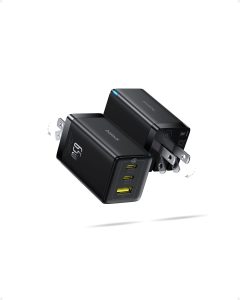
If your budget is tighter and you primarily charge one device at a time, the Anker 313 provides reliable 45W USB-C charging in a compact, simple package. You lose the modularity, AC outlet, and multiple ports, but gain straightforward operation at about two-thirds the price. Choose this if you’re a minimalist charger who doesn’t need simultaneous multi-device power.
Premium Alternative: Anker 737 GaNPrime (120W)
For users needing maximum power across multiple devices, the Anker 737 delivers 120W with more sophisticated power allocation and a built-in display showing power distribution. It’s significantly larger, lacks the AC outlet and modular design, but provides substantially more charging capability. Choose this if you regularly charge power-hungry devices like gaming laptops and tablets simultaneously.
The Baseus occupies a smart middle ground – more capable than basic chargers while remaining more affordable and versatile than premium powerhouses. Its unique value comes from the physical flexibility rather than pure wattage supremacy.
Buying Guide / Who Should Buy
Best for beginners who want a single charging solution that adapts to different scenarios without requiring multiple accessories. The learning curve is minimal enough for casual users, and the versatility means you’re less likely to need additional chargers later.
Best for professionals who travel frequently or work across multiple locations. The ability to function as both wall charger and power strip solves genuine problems in hotels, co-working spaces, and client sites where outlet access is often problematic.
Not recommended for users who need maximum single-device charging speed (gamers, video editors), those who require extensive AC power for appliances, or international travelers needing universal voltage compatibility (the AC outlet supports 100-240V but requires plug adapters).
FAQ
Can it really charge a laptop and phone simultaneously at full speed?
No – when charging a laptop requiring 60W+, the remaining ports provide reduced output. You’ll get laptop charging at full speed plus phone topping, but not simultaneous maximum charging across all devices. This is typical for chargers in this category.
How does the detachable design hold up over time?
After three months of regular use, the connection remains solid with no noticeable loosening. The locking mechanism appears well-engineered, but any modular design inherently has more potential failure points than a solid unit.
Is the 67W output sufficient for modern laptops?
For most Ultrabooks, MacBook Air, and business laptops, yes. For gaming laptops, mobile workstations, or devices with high power demands, you might want more dedicated single-port charging.
What’s the actual advantage of GaN technology?
GaN (Gallium Nitride) allows for more compact designs with better heat efficiency compared to traditional silicon. In practice, this means the Baseus packs multiple ports and an AC outlet into a form factor that would be significantly larger with older technology.
Should I choose this over a traditional power bank?
They serve different purposes – this requires wall power but offers more versatile charging options, while power banks provide true portability but need pre-charging. Many users will want both for different scenarios.