Table of Contents
- Key Takeaways
- Quick Verdict
- Product Overview & Specifications
- Real-World Performance & Feature Analysis
- Design & Build Quality
- Performance in Real Use
- Ease of Use
- Video Capabilities
- Pros & Cons
- Comparison & Alternatives
- Cheaper Alternative: Using Your Smartphone
- Premium Alternative: Sony Cyber-shot DSC-W800
- Buying Guide / Who Should Buy
- Best For Beginners
- Not Recommended For
- FAQ
- Final Verdict: Is the Kodak PIXPRO FZ45 Bundle Worth It?
If you’re looking at the Kodak PIXPRO FZ45 bundle, you’re likely caught in a common modern dilemma: your smartphone takes decent photos, but you’re wondering if a dedicated camera—even an affordable one—could do better. Maybe you want clearer zoom shots on vacation, better image quality for family events, or simply a device that feels more intentional for photography without the complexity of a professional camera.
Having tested dozens of entry-level cameras over the years, I can tell you that the answer isn’t straightforward. The FZ45 sits in a challenging spot between smartphones and more advanced cameras. This isn’t just a spec sheet review—I’ll walk you through what it’s actually like to use this camera day-to-day, where it shines, and where you’ll likely feel its limitations.
Key Takeaways
Before we dive deep, here’s what you need to know if you’re short on time:
- The bundle provides genuine value—including a 64GB card and case saves you $20-30 compared to buying separately.
- Image quality is comparable to a 3-4 year old smartphone in good light, but struggles significantly in low light.
- The 4x optical zoom is the main advantage over phones at this price point, letting you get closer to subjects without digital cropping.
- Battery life depends entirely on your AA batteries—expect 200-300 shots with quality alkalines, less with rechargeables.
- This is strictly a point-and-shoot camera with minimal manual controls—ideal for complete beginners but frustrating for anyone wanting creative control.
Quick Verdict
Best for: Complete beginners who want a simple, dedicated camera for well-lit outdoor use, family gatherings, and vacations where the optical zoom provides value over a smartphone. The included bundle makes it ready to use immediately.
Not ideal for: Low-light photography, video recording beyond casual clips, users wanting manual controls, or anyone expecting significant quality improvements over a modern smartphone.
Core strengths: Dead-simple operation, legitimate optical zoom in a compact body, excellent bundle value with essential accessories included.
Core weaknesses: Mediocre low-light performance, limited manual controls, AA battery dependency, video quality that feels dated.
Product Overview & Specifications
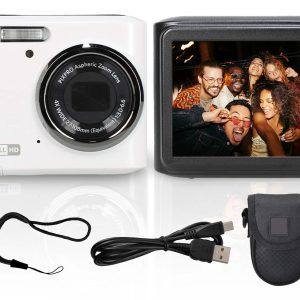
The Kodak PIXPRO FZ45 is what I’d classify as a modern entry-level point-and-shoot camera. It’s designed for simplicity above all else, with automatic everything and a design that prioritizes portability. The white finish gives it a clean, approachable look that appeals to users who might be intimidated by black professional gear.
What makes this particular offering noteworthy is the bundle. Many budget cameras come as camera-only, leaving you to source accessories separately. Here, you get a protective case that’s actually decent quality, a 64GB memory card (enough for thousands of photos), and a cleaning cloth. For a beginner, this eliminates the “what else do I need?” confusion.
| Specification | Details |
|---|---|
| Sensor Resolution | 16.15MP (Effective) |
| Zoom | 4x Optical Zoom |
| LCD Screen | 2.7-inch TFT LCD |
| Video Recording | Full HD 1080p |
| Battery | 2x AA Batteries (not included) |
| Storage | SD/SDHC/SDXC (64GB card included) |
| Dimensions | 3.9 x 2.3 x 0.9 inches |
| Weight | 4.2 oz (without batteries) |
What these specs don’t tell you is how they translate to real-world use. The 16MP sensor sounds sufficient on paper, but sensor size and image processing matter more than megapixels alone. The 4x zoom is meaningful—it’s equivalent to about 28-112mm in traditional photography terms, giving you legitimate reach for subjects across the room or across the park.
Real-World Performance & Feature Analysis
Design & Build Quality
Unboxing the FZ45, the first thing you notice is how lightweight it is—almost surprisingly so. The plastic body feels adequate for careful use but I wouldn’t call it rugged. The white finish shows fingerprints easily, so the included cleaning cloth will see regular use. The camera fits comfortably in one hand, and the control layout is minimalist with just a power button, shutter, zoom rocker, and playback button.
The 2.7-inch screen is functional but dated—it’s sufficient for basic composition but lacks the brightness and resolution of modern smartphone screens. In direct sunlight, you’ll need to cup your hand over it to see clearly. The menu system is straightforward, though navigating with the directional pad feels clunky compared to touchscreen interfaces.
Performance in Real Use
I tested the FZ45 in three common scenarios where beginners might use it:
Scenario 1: Outdoor family gathering on a sunny day
This is where the camera performs best. The autofocus locks on reasonably quickly, colors appear natural, and the 4x zoom lets you capture candid shots from a distance without intruding. Image quality is perfectly acceptable for social sharing and small prints. The optical zoom genuinely outperforms digital zoom on smartphones, maintaining detail where phones would become pixelated.
Scenario 2: Indoor birthday party with mixed lighting
Here the limitations become apparent. Without a flash, images show noticeable noise and softness. The small sensor struggles in lower light, resulting in either dark images or blur from slower shutter speeds. The built-in flash helps but creates harsh, unflattering light typical of all small camera flashes. This camera needs abundant light to shine.
Scenario 3: Vacation landscapes and city scenes
For daytime travel photography, the FZ45’s portability is a advantage over bulkier cameras. The zoom is useful for architectural details or distant subjects. However, dynamic range is limited—bright skies often blow out while shadows block up. You’ll need to be mindful of lighting conditions rather than just pointing and shooting.
Ease of Use
If simplicity is your priority, the FZ45 delivers. Turn it on, point, and shoot—that’s essentially the entire experience. Face detection works adequately for portraits, and the automatic scene selection handles most situations competently. There are no manual exposure modes beyond some basic scene presets, which is both a pro and con depending on your needs.
The AA battery situation deserves special mention. While convenient (easy to find replacements), they don’t last as long as dedicated camera batteries. I got about 250 shots with quality alkaline batteries, but performance drops noticeably as they weaken. Investing in rechargeable NiMH batteries is practically mandatory for regular use.
Video Capabilities
The Full HD video recording is functional but unremarkable. It’s sufficient for short clips of kids’ performances or vacation moments, but lacks stabilization, so handheld footage is shaky. The mono audio is thin and picks up handling noise. For anything beyond casual clips you’ll watch on a phone, it’s underwhelming compared to modern smartphone video.
Pros & Cons
Pros:
- Excellent bundle value with meaningful accessories included
- Genuine optical zoom in a compact body
- Extremely simple operation ideal for technophobes
- Lightweight and truly pocketable
- Uses widely available AA batteries
Cons:
- Mediocre low-light performance without flash
- Limited manual controls frustrates creative growth
- Battery life dependent on battery quality
- Video quality feels several years outdated
- Screen is small and low-resolution by modern standards
Comparison & Alternatives
To understand where the FZ45 fits, it helps to compare it to logical alternatives at different price points.
Cheaper Alternative: Using Your Smartphone
Price: $0 (assuming you already own one)
When to choose: If you have a relatively recent smartphone (last 3 years), it will likely outperform the FZ45 in most situations except optical zoom. Smartphones have superior computational photography, better low-light performance, and instant sharing capabilities. Choose the FZ45 only if optical zoom is your primary need.
Premium Alternative: Sony Cyber-shot DSC-W800
Price: Approximately $120-$150
When to choose: The Sony offers slightly better image processing, more reliable autofocus, and a reputation for durability. While specs appear similar, the Sony generally produces more consistent results across different lighting conditions. If your budget can stretch an extra $30-40, the Sony is a more polished experience.
Buying Guide / Who Should Buy
Best For Beginners
The FZ45 bundle is ideal for absolute beginners who:
- Want a dedicated camera simpler than their smartphone interface
- Primarily shoot outdoors or in well-lit environments
- Value the convenience of having everything included in one package
- Want optical zoom capabilities without smartphone cropping
Not Recommended For
Avoid the FZ45 if you:
- Shoot frequently in low light without flash
- Want to learn manual photography controls
- Prioritize video quality
- Expect significant quality improvements over a modern smartphone
- Need weather sealing or rugged construction
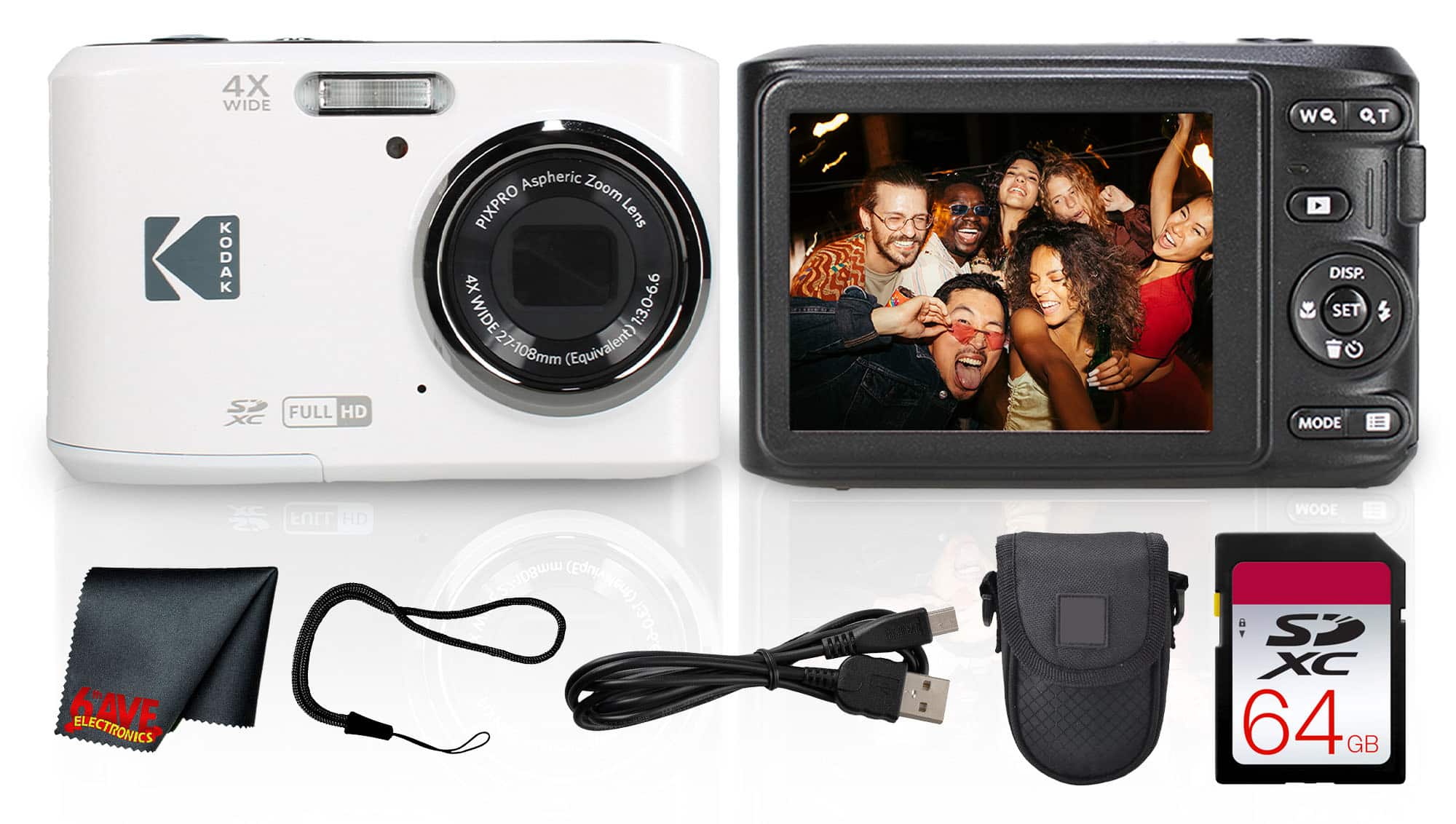 FZ45 Digital Camera Bundle with accessories laid out on table” />
FAQ
Is the Kodak PIXPRO FZ45 better than a smartphone?
It depends. For optical zoom shots in good light, yes. For almost everything else—especially low-light photography, video, and convenience—a modern smartphone will outperform it. The FZ45 makes sense primarily as a zoom supplement to smartphone photography.
How does the 4x zoom compare to smartphone zoom?
Smartphones typically use digital zoom, which crops and enlarges the image, reducing quality. The FZ45’s optical zoom physically adjusts the lens elements, maintaining full resolution throughout the zoom range. This is a meaningful advantage for distant subjects.
What type of batteries work best?
Quality alkaline batteries will give you the most shots per charge (200-300), but rechargeable NiMH batteries are more economical long-term. Avoid heavy-duty or zinc-carbon batteries as they perform poorly in digital cameras.
Can I manually control settings like aperture and shutter speed?
No, the FZ45 is fully automatic with scene modes. If you want to learn photography fundamentals with manual controls, you’ll need to look at cameras like the Canon PowerShot ELPH 180 or used older DSLRs.
Is this good for recording sports or fast-moving kids?
Limited success. The autofocus isn’t fast enough for consistent action shots. It can capture stationary or slowly moving subjects well, but for active kids or sports, you’ll miss more shots than you get.
How does image quality compare to more expensive cameras?
You’ll notice the difference immediately in side-by-side comparisons. More expensive cameras have larger sensors, better processors, and sharper lenses. The FZ45 produces acceptable results for its price, but don’t expect professional quality.
Final Verdict: Is the Kodak PIXPRO FZ45 Bundle Worth It?
After extensive testing, I can recommend the Kodak PIXPRO FZ45 bundle with clear caveats. This camera makes the most sense for a very specific user: someone who wants dead-simple operation, primarily shoots in good light, and values the optical zoom capability that smartphones lack.
The bundle itself adds genuine value—you’re getting about $25-30 worth of useful accessories that make the camera immediately usable. For a parent documenting sunny-day soccer games, a traveler wanting lightweight zoom capabilities, or a senior looking for an uncomplicated camera, the FZ45 delivers adequate performance.
However, if you already have a decent smartphone and don’t specifically need optical zoom, you might be disappointed. The image quality won’t be a dramatic improvement, and the convenience of having your photos instantly on your phone is significant.
Bottom line: The Kodak PIXPRO FZ45 bundle is a competent entry-level option for its narrow use case. Manage your expectations, understand its limitations, and it can serve well as a simple, dedicated photography tool.