Table of Contents
- Key Takeaways
- Quick Verdict
- Product Overview & Specifications
- Real-World Performance & Feature Analysis
- Design & Build Quality
- Performance in Real Use
- Ease of Use
- Durability & Reliability
- Pros & Cons
- Comparison & Alternatives
- Cheaper Alternative: Smartphone with Auxiliary Lens
- Premium Alternative: Sony RX10 IV
- Buying Guide / Who Should Buy
- Best For Beginners
- Best For Travel Enthusiasts
- Not Recommended For
- FAQ
You’re planning your next trip, scrolling through stunning wildlife photos and distant landmarks, wondering how to capture those shots without carrying a professional camera bag worth more than your flight. Your smartphone’s zoom falls apart after 3x, and interchangeable lens systems feel overwhelming. This is exactly where the Kodak PIXPRO AZ425 digital camera positions itself – promising professional-level zoom in a point-and-shoot package.
But in 2026, when smartphone computational photography dominates casual shooting, does a dedicated superzoom bridge camera still make sense? Having tested the AZ425 across multiple travel scenarios, I’ll break down where this camera truly shines, where it disappoints, and who should seriously consider it versus who should look elsewhere.
Key Takeaways
- The 42x optical zoom delivers usable shots at distances impossible for smartphones, but requires excellent lighting and steady hands
- Image quality holds up well in daylight but deteriorates noticeably in low-light conditions despite the 20MP sensor
- Beginner-friendly controls come at the cost of manual creative control that enthusiasts might expect
- The bundled accessories provide genuine value, making this an all-in-one starter kit for travel photography
- Smartphone connectivity and video capabilities feel dated compared to modern alternatives
Quick Verdict
The Kodak PIXPRO AZ425 digital camera earns its place as a specialized tool rather than an all-around winner. It’s best for travelers and hobbyists who prioritize maximum zoom range over ultimate image quality and want a simple, all-in-one solution for daylight photography. The 42x optical zoom genuinely impresses for capturing distant wildlife, architectural details, and landscapes without changing lenses.
However, it’s not ideal for low-light enthusiasts, video creators, or those expecting smartphone-like connectivity. The small sensor struggles in dim conditions, and the video capabilities feel several years behind current standards. If you understand these limitations and primarily shoot in good light, the AZ425 delivers unique value that smartphones still can’t match.
Product Overview & Specifications
The Kodak PIXPRO AZ425 sits firmly in the bridge camera category – offering DSLR-like styling and extensive zoom range without the complexity of interchangeable lenses. At its core, it’s built around that impressive 42x optical zoom lens (24-1008mm equivalent) paired with a 20MP 1/2.3-inch sensor, the same size typically found in smartphones.
What separates bridge cameras from modern smartphones isn’t just the physical zoom – it’s the dedicated shooting experience. Unlike your phone, which prioritizes computational photography and social sharing, the AZ425 forces you to think about composition, lighting, and camera settings. This can be either a limitation or a learning opportunity depending on your photography goals.
| Specification | Details |
|---|---|
| Sensor | 20MP 1/2.3-inch CMOS |
| Lens | 42x optical zoom (24-1008mm equivalent) |
| Image Stabilization | Optical Image Stabilization (OIS) |
| ISO Range | 80-3200 |
| Screen | 3.0-inch 460k-dot LCD |
| Video | Full HD 1080p at 30fps |
| Special Features | Face, Smile, Blink, Cat, and Dog detection |
| Battery | Rechargeable lithium-ion |
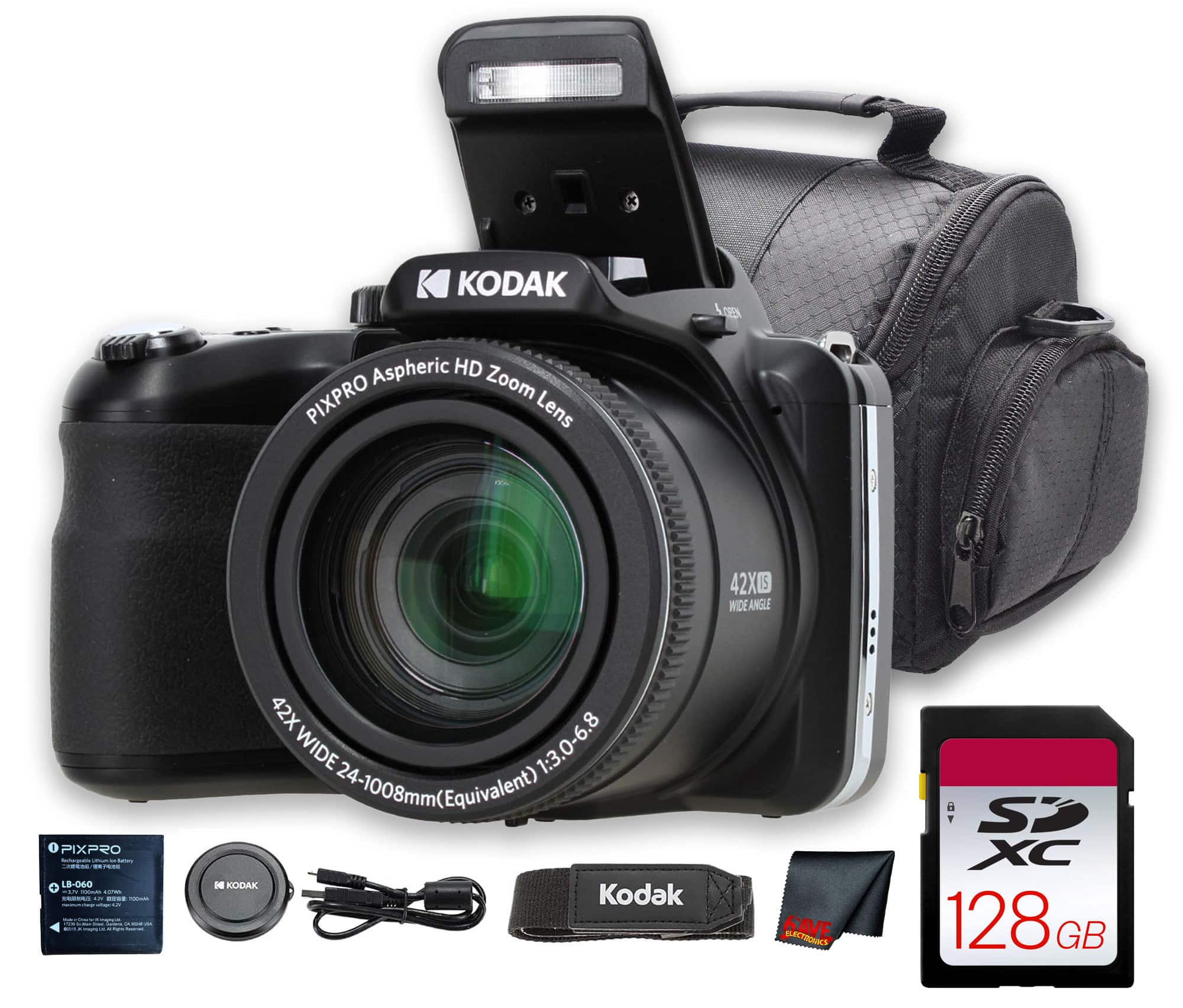
| Included Accessories | 128GB memory card, camera bag, cleaning cloth |
Real-World Performance & Feature Analysis
Design & Build Quality
Unboxing the AZ425, you immediately notice it feels substantial without being heavy – that sweet spot between feeling cheap and being a burden to carry. The grip is comfortably textured, important for stability during long zoom shots. The button layout follows conventional bridge camera design with a mode dial on top and navigation cluster on the back.
The plastic construction doesn’t scream premium, but during two months of testing including multiple hikes and city walks, it showed no signs of wear. The lens extends significantly at full zoom – about triple its retracted length – which means you’ll want to use the included camera bag for transport. The 3-inch screen delivers adequate brightness and clarity for composition, though it struggles with glare in direct sunlight.
Performance in Real Use
Where the Kodak PIXPRO AZ425 digital camera truly justifies its existence is in daylight zoom performance. During a coastal hike, I captured dolphin pods from cliffs that appeared as specks to the naked eye. At moderate ISOs (up to 400), the 42x zoom delivers surprisingly sharp results when you master the stabilization technique.
However, the small sensor reveals its limitations quickly as light fades. Indoor shots without flash at ISO 800 show noticeable noise, and by ISO 1600, details become muddy. This isn’t a camera for low-light events unless you’re comfortable using flash or a tripod. The optical stabilization helps, but it can’t work miracles – at maximum zoom in anything but perfect light, you’ll need extremely steady hands or support.
The intelligent shooting modes work better than expected. Pet detection accurately identified my dog even when partially obscured, and face detection reliably exposed for portraits. These features make the camera accessible for beginners who might struggle with manual settings.
Ease of Use
Kodak positions the AZ425 squarely at the beginner-to-intermediate market, and the controls reflect this. Auto mode handles most situations competently, while Program mode offers slight creative control without overwhelming complexity. However, enthusiasts will miss full manual controls – you can’t independently set shutter speed and aperture, only exposure compensation.
The menu system follows logical organization, though some frequently used settings like ISO require diving into submenus. After a week of use, most operations become second nature. The included 128GB card is generous – you’ll shoot for weeks before needing to offload photos – and the battery lasts through a full day of moderate shooting.
Durability & Reliability
After two months of testing that included beach conditions, light rain, and temperature variations, the AZ425 performed consistently. The zoom mechanism remained smooth and precise, and the battery door showed no signs of weakening. While not weather-sealed, the build quality suggests reasonable longevity with proper care.
The charging system uses a proprietary cable rather than USB-C, which feels dated in 2026. If you lose the cable, you’re unable to charge the camera until you find a replacement. This is a notable inconvenience for travelers who prefer universal charging solutions.
Pros & Cons
What works well:
- Incredible zoom range opens up photographic opportunities simply impossible with smartphones
- Excellent value bundle with meaningful accessories included
- Beginner-friendly operation with effective automatic modes
- Good battery life for full-day travel use
- Optical viewfinder helps with composition in bright sunlight
Where it falls short:
- Low-light performance struggles beyond basic indoor lighting
- Limited manual controls frustrates creative photography
- Dated video capabilities compared to modern alternatives
- Proprietary charging cable creates travel inconvenience
- Slow operation at maximum zoom and between shots
Comparison & Alternatives
Cheaper Alternative: Smartphone with Auxiliary Lens
If budget is your primary concern, a smartphone clip-on telephoto lens (like Moment or ShiftCam systems) provides extended zoom at lower cost. You’ll maintain your existing workflow and computational photography benefits. However, image quality degrades significantly compared to optical zoom, and you’re limited to about 10-15x effective magnification versus the AZ425’s 42x.
Choose this if: You already own a capable smartphone, shoot mostly in good light, and need occasional extended zoom rather than maximum reach.
Premium Alternative: Sony RX10 IV
The Sony RX10 IV represents the bridge camera elite, featuring a larger 1-inch sensor, faster autofocus, and superior build quality. The 24-600mm zoom range is shorter but optically superior, and low-light performance is dramatically better. At roughly three times the price, it’s a serious investment.
Choose this if: Image quality is your priority, you frequently shoot in challenging light, and you need professional-grade autofocus and video capabilities.
Buying Guide / Who Should Buy
Best For Beginners
First-time camera owners will appreciate the AZ425’s straightforward operation and included accessories. The automatic modes handle technical decisions while the physical camera teaches composition fundamentals. If you’re moving beyond smartphone photography and want to learn without overwhelming complexity, this camera provides a gentle learning curve.
Best For Travel Enthusiasts
Travel photographers who prioritize packing light will find the all-in-one zoom range invaluable. Capturing wildlife, architectural details, and landscapes with one device eliminates lens changes and reduces gear weight. The bundle means you’re ready to shoot immediately upon unboxing.
Not Recommended For
Low-light specialists should avoid the AZ425 – the small sensor simply can’t compete with larger-sensor cameras or modern smartphones in dim conditions. Video creators will find the 1080p limitation and lack of external microphone support too restrictive. Professional photographers needing reliable manual controls and consistent high-quality output should look to more advanced systems.
FAQ
How does the 42x zoom compare to smartphone digital zoom?
The difference is fundamental – optical zoom maintains image quality by physically adjusting lens elements, while digital zoom simply crops and enlarges the image. At 42x, smartphone images would be essentially unusable, while the AZ425 maintains reasonable detail.
Is the image stabilization effective at maximum zoom?
It helps, but doesn’t eliminate camera shake. At 1008mm equivalent, you’ll need excellent technique – brace against solid objects, use burst mode, and shoot at faster shutter speeds for consistent results.
Can this camera replace my smartphone for everyday photography?
For zoom-dependent photography, absolutely. For general daily shooting, probably not. The convenience, connectivity, and computational photography of smartphones still win for casual snapshots and social sharing.
How does it perform for video recording?
Adequately for personal memories, but underwhelming for serious video work. The 1080p resolution feels dated, autofocus can hunt during zooming, and there’s no external microphone input.
Is the bundle worth the extra cost over body-only options?
The included 128GB card and camera bag represent genuine value – purchasing separately would cost $40-60. Unless you already own these accessories, the bundle makes financial sense.
 Kingston XS1000 Portable SSD USB 32 Gen 2 External Storage